About the MNBG Seed Bank
A crucial question is whether coastal dune plants can tolerate increasing salinity, at least well enough to migrate inland as the sandy beaches erode due to sea level rise.
by Dr. Kasey Barton,
School of Life Sciences, UH-Mānoa

MNBG's efforts to conserve coastal native Hawaiian plants is supported by Maui Ocean Center . A portion of the proceeds from their Hawaiian Culture and Botanical Plant Tour goes to Maui Nui Botanical Gardens every month.
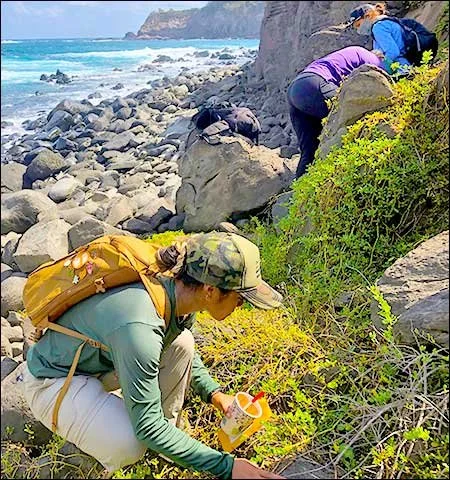
Horticulturalist Emmely Felipe collecting ‘Ōhelo kai on Maui’s North Shore
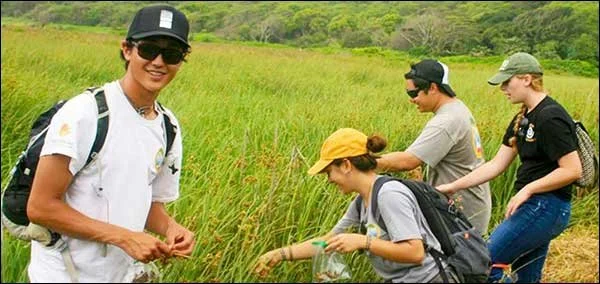
Na Hua Hoʻohuli i ka Pono interns collecting Kaluha at Waihee Dunes
Maui Nui Botanical Gardens is located on a remnant consolidated dune system, where coastal native plants flourish. We want the Garden to be useful to people who currently protect native plants and natural areas, and those who wish to do so in the future. Sometimes this means collecting and storing seeds of the coastal, low elevation, and wetland Maui Nui plants in our collection. These cultivated plants are great for landscapes in low elevation areas and we often give away coastal plant starts at our weekly plant giveaways. Check @mauinuibg for this week's selection.
But cultivated plants rarely have the genetic diversity represented by wild plants in natural areas. With permission from landowners, we collect whenever possible from remnant native plant populations along a variety of shoreline habitats. These wild seeds belong to the landowner, and are processed, dried, and stored to protect viability for use in future projects. For example, seeds collected along the North Shore of Maui have been withdrawn and grown for restoration plantings in a protected seabird nesting area near Hoʻokipa by the Maui Nui Seabird Recovery Project.
Native Hawaiian plants that prefer coastlines are a major interest at MNBG. You've probably seen common native species like Naupaka kahakai (Scaevola taccada) and Pōhuehue (Ipomoea pes-caprae), but Hawaiian coastlines have been completely altered by human use, excluding the plants that would naturally grow there. You can still see intact native coastal vegetation, with its multitude of species, at The Nature Conservancy’s Mo‘omomi Preserve on Moloka‘i, and Kaena Point Natural Area Reserve on O‘ahu. On Maui, Kanahā Beach Park near the sewage treatment plant is replanted with native plants that have been lovingly tended for years, mostly by a single volunteer. Mauka is Kanahā Pond State Wildlife Sanctuary, where native birds, native plants, and a natural wetland are protected, as they are at the Keālia Pond National Wildlife Refuge across the isthmus. The Hawai‘i Land Trust’s Waihe‘e Coastal Dunes and Wetland Refuge has a beautiful assemblage of restored coastal native plants along the rocky beaches. If you are willing to hike farther, the King’s Trail at ‘Āhihi Kīna‘u Natural Area Reserve will lead you to Kanaio Beach, which still has wild naio, pā‘u ō hi‘iaka, and others. Places and projects like these show us that Maui’s most popular coasts are important to more life forms than just people.
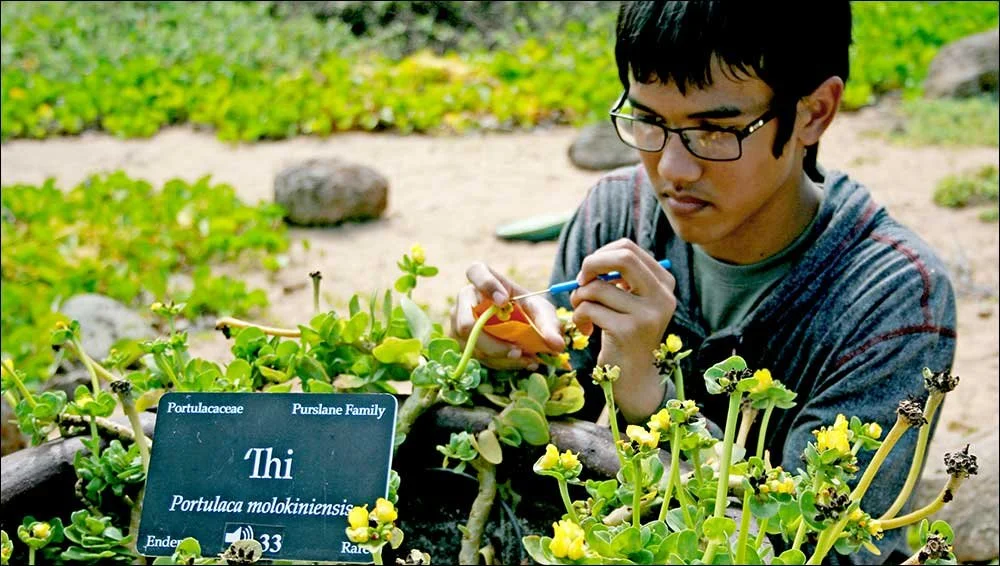
Collecting seeds from coastal plants at Maui Nui Botanical Gardens
Conserving native coastal dune plants is a conservation priority, which depends on understanding the ecology of dune species. Coastal environments are inherently stressful for plants. High solar radiation, intense winds, and trampling from human activities pose persistent challenges to plant survival and growth. In addition, periodic and unpredictable events such as big storms and king tides can devastate dune habitats. These are routine stressors that coastal dune plants face and, as a consequence, they have evolved traits and growth strategies to maximize stress tolerance. However, coastal environments are changing, and dune plants are increasingly threatened by climate change and habitat loss due to coastal erosion. For low-lying coastal zones, sea level rise poses a serious threat, leading to increasing salt water intrusion below the sand where roots access freshwater lenses.
by Dr. Kasey Barton,
School of Life Sciences, UH-Mānoa
Seed Bank Articles from the Maui Nui Botanical Gardens Newsletter
Please Consider
Making a Donation